This package allows you read and modify projects of other users. To do that, it has to be authorized to make API calls on that user's behalf. This user can be you, or other users that use your app. On this page we explain how you can authorize your app, so you and others can use it on their own projects.
For apps running in the browser, app authorization typically looks like this:
- User presses "Login" on your page
- User is shown a page on audiotool.com asking "This app requests to do xyz for you, Allow?"
- User presses "Allow" and comes back to your page, now logged in
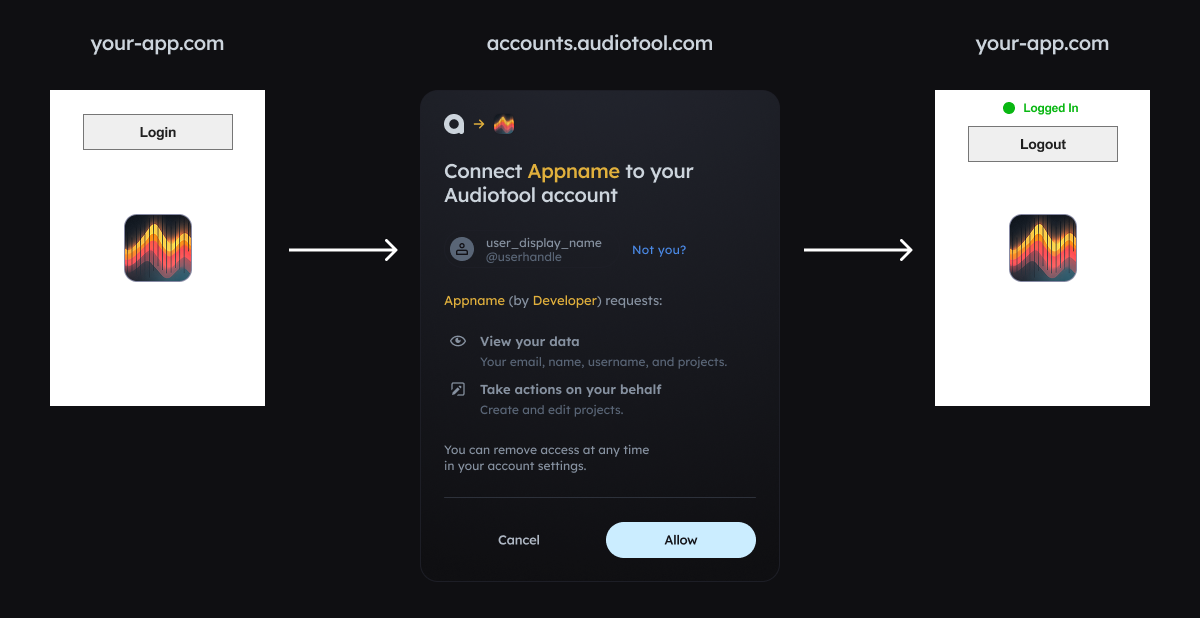
The login flow described here is intended for browser-based apps. For server-side apps, you can use PAT-based authentication.
Registering your application
Register your application on developer.audiotool.com/applications. Press "Create Application" and fill in the following details:
- Name/Description/Project URL - as you want
- Redirect URI: enter
https://127.0.0.1:5173/for now, later your project's deployed URL - scopes:
project:writefor creating a synced document
Running your server on 127.0.0.1:5173
We just set "redirectURI" to http://127.0.0.1:5173/. This is the URL that accounts.audiotool.com forwards the user back to after
they press allow. If you deploy your app to foo.com, you will have to add https://foo.com/ to that list.
For security reasons, this URL can't be localhost. Instead, we have to configure the local dev server to host our app
under the http://127.0.0.1:5173/. In vite, you can do this as follows: Open vite.config.ts (or create it if it doesn't exist yet) and add the following:
import { defineConfig } from 'vite'
export default defineConfig({
...
server: {
host: '127.0.0.1',
...
port: 5173,
},
})
Checking if the user is logged in
To start the login flow, call getLoginStatus, which reports whether a user is currently logged in or not. If there is, you can use the return value to authorize the AudiotoolClient, and modify projects on that user's behalf. If there is not, you can't create an AudiotoolClient yet. For this reason, you should call this function early and decide what you wan to show to the user if they're logged out.
The very first time that getLoginStatus is called, it will always report that no user is logged in. In that case, the return value
has a login() method that will start the login flow shown above: The user is forwarded to accounts.audiotool.com, where they can
press "Allow", and then return to your app. Once they return, the same getLoginStatus is executed again, this time reporting that a user is
logged in. Once a user is logged in, they stay logged in for days/weeks, until the logout() function is called again.
getLoginStatus takes the authorization information we entered on developer.audiotool.com/applications:
import { getLoginStatus } from "@audiotool/nexus"
const status = await getLoginStatus({
clientId: "<client-id of your app>",
redirectUrl: "http://127.0.0.1:5173/",
scope: "project:write",
})
if (status.loggedIn) {
console.debug("Logged in!!")
} else {
console.debug("Not logged in.")
}
The return value has two variants - logged in and logged out. If it's logged in, you have a method logout(); if it's logged out, you have a method login().
You should wire up these methods to buttons so the user can choose to login:
const createButton = (text: string, onClick: () => void) => {
const button = document.createElement("button")
button.innerHTML = text
button.addEventListener("click", onClick)
document.body.appendChild(button)
}
if (status.loggedIn) {
createButton("Logout", () => {
// will refresh the tab with authentication information removed
status.logout()
})
console.debug("Logged in as", await status.getUserName())
} else {
createButton("Login", () => {
// will forward the user to accounts.audiotool.com
status.login()
})
}
If (and only if) the status is loggedIn, you can forward it to the AudiotoolClient to create an authorized client:
const client = createAudiotoolClient({
authorization: status,
})
Full example
import { createAudiotoolClient } from "@audiotool/nexus"
import { getLoginStatus } from "@audiotool/nexus"
const createButton = (text: string, onClick: () => void) => {
const button = document.createElement("button")
button.innerHTML = text
button.addEventListener("click", onClick)
document.body.appendChild(button)
}
// get current login status
const status = await getLoginStatus({
clientId: "bd496109-d9b4-4b6a-8519-8b6ce88b58c5",
redirectUrl: "http://127.0.0.1:5173/",
scope: "project:write",
})
// Check if user if logged in, create login/logout buttons
if (status.loggedIn) {
console.debug("Logged in as", await status.getUserName())
createButton("Logout", () => status.logout())
const client = createAudiotoolClient({authorization: status})
...
} else {
console.debug("Logged out.")
createButton("Login", () => status.login())
}
Deploying your app
To deploy your app, you need to update the redirectUrl so that the user is redirected to your page's URL rather than http://127.0.0.1:5173/. To do this:
- add that (entire) URL as "redirectURI" on your app at developer.audiotool.com/applications
- when calling
getLoginStatus, pass that URL asredirectUrl
Troubleshooting
-
make sure the
redirectURLmatches theredirectURIyou specified on developer.audiotool.com/applications exactly - pay attention in particular to the/character in the end. -
if you get
insufficient_permissionserror even if logged in, the "Scopes" you set in your app & pass to getLoginStatus are likely insufficient for the API calls you're trying to make. Theprojects:writescope we use in the example above grants access to create and modify projects, but for other API calls, other scopes are needed. We're working on documentation in that regard.If you need more scopes, update your app on developer.audiotool.com/applications, and then pass the scopes to getLoginStatus, separated by spaces. Already logged in users have to be logged out & in again for the new scopes to take effect. If your app is already deployed and users are already logged in, consider creating a new application on developer.audiotool.com/applications so all users are automatically logged out again. We'll make this process smoother at some point.
-
for more issues and questions, join our discord: https://discord.gg/5Cde4Zvret
Client ID, scopes, and redirect URIs can safely be:
- hard-coded into your app
- checked into git
- sent to your users' browsers
- shared with friends and foes
Only websites at the redirect URIs you specify for your app on developer.audiotool.com can use it to authorize their apps.
Advanced
PAT-based authentication
For server-side apps that you don't plan to ever share with other users, you can also use a Personal Access Token and pass that into the audiotool client:
const client = createAudiotoolClient({
authorization: "at_pat_238u098i23...",
})
The PAT grants full access to your entire audiotool account. Never share it with others or check it into git!!
Rolling your own OAuth flow
You can implement the token exchange with accounts.audiotool.com yourself. The authorization argument of createAudiotoolClient is string | { getToken(): Promise<string | Error>}. You can use the second variant to pass in your token, potentially refreshing it before it's used.
We will publish the source code of getLoginStatus soon.
Using credentials in your own network calls
If you'd like to make your own calls to our API and just use the getLoginStatus mechanism to authorize the user, you can configure your fetch call as follows:
fetch(apiUrl, {
// must omit credentials, otherwise you get a CORS error
credentials: "omit",
headers: {
// pass the token through the authorization header
authorization: await status.getToken(),
},
})