The package should be considered "early alpha" and can change significantly between releases, even between minor version numbers.
To get more background on the changes we make, join our Discord.
0.0.16 & 0.0.17
New sample API, helper methods to:
- download a sample
- upload a sample
- insert a sample into a project
Check SamplesAPI and TransactionBuilder.insertSample for more infos. If you're working with samples, we think it's much easer to use - give it a look!
0.0.15:
- Updated Consolidation Logic - for a more robust experience modifying projects alongside other participants
- Updated defaults - newly created entities now match the DAW
- New Goodies in PresetsAPI:
- use
at.presets.getInstrument("marimba")to get the marimba instrument - use
at.presets.getDrums("jazz-kit")to get the jazz drum kit - use
at.presets.getInstrument(8)to use instrument with GM Program number8(see [1]) - use
at.presets.getDrums(8)to get the Room Kit (available programs: 0, 8, 16, 24, 25, 32, 40, 48) - use
at.presets.gmInstrumentsto get a list of all GM instruments, incl..displayName,.description, and.programto get the GM number. - use
at.presets.gmDrumsto get a list of all GM drums, like the other one - usage:
const preset = await at.presets.getInstrument("pan-flute")
await nexus.modify((t) => {
// all GM instruments are gakki devices
const gakki = t.createDeviceFromPreset(preset)
}) - use
See a list of all available instruments at GmInstrumentSlug, drums at GmDrumSlug.
[1]: For background on GM program numbers, see General MIDI on Wikipedia. Many listings show programs as 1–128; in this SDK they are 0-indexed per MIDI 1.0.
0.0.13 & 0.0.14
Breaking Changes
- New authentication API -
audiotool()replacesgetLoginStatus()and returns the client directly when authenticated - Flattened API - Services are now directly on the client:
client.api.projectService→client.projectsclient.api.userService→client.usersclient.api.sampleService→client.samplesclient.api.projectRoleService→client.projectRolesclient.api.presets→client.presetsclient.api.audioGraphService→client.audioGraph
- Renamed
createSyncedDocumenttoopen- More intuitive:client.open("...") createAudiotoolClient()signature changed - Now takes{auth, transport}instead of{authorization}- Removed exports:
getLoginStatus,LoggedInStatus,LoggedOutStatus,LoginStatus,AudiotoolAPI,createAudiotoolAPI
New Features
- New
@audiotool/nexus/nodeexport for Node.js/Bun/Deno server-side usage - Fixed Vite browser builds - main entry no longer imports Node.js-specific code
- Added
createServerAuth()for using browser OAuth tokens server-side - Added
createPATAuth()for PAT-based authentication - Added
exportTokens()to authenticated client for server-side token handoff
Prompt for an agent:
Migrate my code from @audiotool/nexus 0.0.12 to 0.0.14. Apply these changes:
1. Replace `getLoginStatus({clientId, redirectUrl, scope})` with `audiotool({clientId, redirectUrl, scope})`.
- `status.loggedIn` becomes `at.status === "authenticated"`
- `!status.loggedIn` becomes `at.status === "unauthenticated"`
- `status.login()` / `status.logout()` become `at.login()` / `at.logout()`
- `status.getUserName()` becomes `at.userName` (sync, no await)
2. Remove `createAudiotoolClient({authorization: status})`. When `at.status === "authenticated"`,
`at` IS the client — use it directly.
3. Replace `client.api.projectService` with `client.projects`,
`client.api.userService` with `client.users`,
`client.api.sampleService` with `client.samples`,
`client.api.projectRoleService` with `client.projectRoles`,
`client.api.presets` with `client.presets`,
`client.api.audioGraphService` with `client.audioGraph`.
4. Replace `client.createSyncedDocument({project: url})` with `client.open(url)`.
5. For Node.js: add `import { createNodeTransport, createDiskWasmLoader } from "@audiotool/nexus/node"`
and pass `transport: createNodeTransport(), wasm: createDiskWasmLoader()` to `createAudiotoolClient`.
6. Remove imports of: getLoginStatus, LoggedInStatus, LoggedOutStatus, LoginStatus,
AudiotoolAPI, createAudiotoolAPI — these no longer exist.
7. The Beatbox 8 and Beatbox 9 drum machines now map MIDI notes to drum sounds
following the General MIDI percussion standard (matching Gakki and MIDI files).
If your code writes notes to bb8/bb9 pattern steps by MIDI key number, use this
mapping (same for all three: bb8, bb9, Gakki):
| Key | Note | Drum Sound | Key | Note | Drum Sound |
| --- | ---- | ------------------ | --- | ---- | -------------- |
| 35 | B0 | Acoustic Bass Drum | 59 | B2 | Ride Cymbal 2 |
| 36 | C1 | Bass Drum 1 | 60 | C3 | Hi Bongo |
| 37 | C#1 | Side Stick | 61 | C#3 | Low Bongo |
| 38 | D1 | Acoustic Snare | 62 | D3 | Mute Hi Conga |
| 39 | Eb1 | Hand Clap | 63 | Eb3 | Open Hi Conga |
| 40 | E1 | Electric Snare | 64 | E3 | Low Conga |
| 41 | F1 | Low Floor Tom | 65 | F3 | High Timbale |
| 42 | F#1 | Closed Hi Hat | 66 | F#3 | Low Timbale |
| 43 | G1 | High Floor Tom | 67 | G3 | High Agogo |
| 44 | Ab1 | Pedal Hi-Hat | 68 | Ab3 | Low Agogo |
| 45 | A1 | Low Tom | 69 | A3 | Cabasa |
| 46 | Bb1 | Open Hi-Hat | 70 | Bb3 | Maracas |
| 47 | B1 | Low-Mid Tom | 71 | B3 | Short Whistle |
| 48 | C2 | Hi Mid Tom | 72 | C4 | Long Whistle |
| 49 | C#2 | Crash Cymbal 1 | 73 | C#4 | Short Guiro |
| 50 | D2 | High Tom | 74 | D4 | Long Guiro |
| 51 | Eb2 | Ride Cymbal 1 | 75 | Eb4 | Claves |
| 52 | E2 | Chinese Cymbal | 76 | E4 | Hi Wood Block |
| 53 | F2 | Ride Bell | 77 | F4 | Low Wood Block |
| 54 | F#2 | Tambourine | 78 | F#4 | Mute Cuica |
| 55 | G2 | Splash Cymbal | 79 | G4 | Open Cuica |
| 56 | Ab2 | Cowbell | 80 | Ab4 | Mute Triangle |
| 57 | A2 | Crash Cymbal 2 | 81 | A4 | Open Triangle |
If your existing code used the old bb8/bb9 mapping (where notes were assigned
to pads in a different order), update the note numbers to match the table
above. The same note numbers now work across bb8, bb9, and Gakki, so any
drum-writing helper you have can be unified.
0.0.12
- updated networking code to work better in node.js: Connection no longer hangs on creation, and termination after
nexus.stop()is faster.
0.0.11
- index.AudiotoolClient.createSyncedDocument | AudiotoolClient.createSyncedDocument (now:
open) changed it's signature:mode: "online"is no longer needed - the document is always online and synced:
const client = ...
const nexus = await client.createSyncedDocument({ project})
-
new function createOfflineDocument, allowing you to create offline documents without any network calls:
const nexus = createOfflineDocument()
0.0.10
- enable creating multiple synced documents at once
- enable stopping an old document from syncing so it can be thrown away: SyncedDocument.stop. This will flush all existing modifications to the backend, then prohibit from using anything in the document other than SyncedDocument.queryEntities.
- improved link formatting in docs
0.0.9
- fixed bug in project synchronization logic that resulted in exceptions in certain situations
- internal restructuring in preparation for open sourcing
- validator wasm got a perf boost, reducing load time of projects
0.0.8
Change README file shown on npm.
v0.0.7
Internal Changes
- improved load time of package drastically by fetching wasm from CDN when running the package in the browser
- added tests for bun, node.js, and browser, preparing for CI tests
- restructure repo preparing to open source
Documentation
- wrote document Overview, giving a high level introduction of the package's functionality, and absorbing previous pages "Transaction Management", "Queries and Navigation", "Events and Changes", and "Core Concepts"
- rename "API Wrappers" to "API", rewrote, absorbed "Presets"
- improved docs of various typescript elements
API
A few exports were moved around, otherwise no change.
v0.0.6
We're now on npm! 🥳
Install the package with:
npm install @audiotool/nexus
API
- refactored and simplified authentication. Managing User Login
- updated the API bindings to the newest version, some change slipped through the last time
Documentation
- updated Getting Started, Managing User Login, and the quick start example in the index
v0.0.5
This is a big update with lots of changes! Existing apps will sadly break, but we hope these updates will make writing nexus apps more fun and easy to use!
Here's a summary:
- the ability to self host your app!
- the new gakki soundfontplayer & audio region repitching: Gakki, FOO.
- a major revision of the entire API structure - hopefully the last one!
You must update your package to keep your app working, older versions won't work anymore.
The biggest changes in the API revision are:
- The
DesktopPlacementmessage is gone. It's content (x/yposition anddisplay_name) is now directly inside the messages thatDesktopPlacementused to point to:t.create("tonematrix", {positionX: 2, positionY: 3, displayName: "foo"}) - The
Stageboxmessage is gone - theMixerMaster(formerly:MixerOut) contains the stagebox'sx/ypositions directly - Mixer strips don't have to point to the
MixerMaster(formerly:MixerOut) anymore:- Channels, Group and Aux strips don't have to be connected to the master anymore, they're implicitly connected
MixerStripCablerenamed toMixerStripGrouping, and is used purely for grouping strips
These changes address the issue where API users:
- forget to add
DesktopPlacement-> device not visible on the desktop - forget to add
Stagebox-> stagebox not visible on the desktop - forget to add a
MixerStripCable-> mixer strip not shown, nothing audible
Now you can forget all these things for good!
Further, the SDK itself got an update in documentation & package names:
- new top level package names:
api-types->api,entity-types->entities - removed
Typesuffix for entity names:TonematrixType->Tonematrix - removed entity messages from api exports, confusing
- grouped entities at entities
- created an overview of all entities, see Entities Overview
Other important changes:
Other important changes
PatternRegionson the timeline no longer have to have a pointer to the pattern device - the device is only referenced through thePatternTrackitself; the pattern index through thepattern_indexfield in the region.Beatbox8,Beatbox9,Machiniste: pattern step duration is set to an enum rather than tick duration- Hundreds of fields got better documentation and names, and dozens got more sensible validity ranges.
CentroidChannelscan now properly be ordered usingorder_among_channels, a float-based ordering similar to tracksRasselbockeffects are ordered similarly: in an array offloatsWaveshaperAnchors can no longer generate an invalid waveshaper - 1 anchor point is always implicitly present
v0.0.4
API
-
expanded subscription capabilities for event manager, see NexusEventManager:
nexus.events.onCreate("*", ...)to subscribe to any entity being creatednexus.events.onRemove("*", ...)to subscribe to any entity being removed-
to subscribe to the removal of an entity that was just creatednexus.events.onCreate("...", () => {
return () => console.debug("removed")
})
-
added better "presets" API wrapper to more easily access presets. See
Presets
Documentation
-
Added default values & validity ranges to the documentation of fields in the "constructor types", the second argument e.g. for
t.create("foo", {...}).This means you can now hover the parameter to see it's validity range:
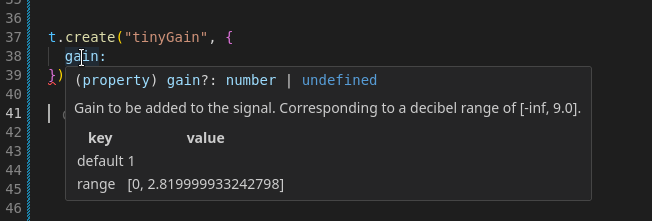
-
Document what pointer fields point to by linking to all locations. See e.g. DesktopAudioCable.fromSocket
-
Remove default from required pointers; confusing because required pointers' default values will result in a transaction error
-
Fix incorrect example in
Core Concepts -
Add documentation pages:
Events and ChangesPresets
Bug Fixes
- fix a bug in the validator that would cause the removal of certain entities to result in a transaction errors when it shouldn't have
v0.0.3
API
- Expose new
Ticksconstants & conversion methods to more easily work with time units
Documentation
- add links to
EntityQuerytoQueries and Navigationdocs, links toTransactionBuildertoTransaction Managementdocs
v0.0.2
API
- started versioning package so we can communicate changes here
- remove
setPAT&hasPATfromAudiotoolClient. Instead, pass the PAT directly tocreateAudiotoolClient. They relied onlocalStorage, making them harder to run on platforms other than the web. Users should manage the PAT themselves, and pass in when creating the client. For websites, you could use e.g. localStorage. - improve error message if calling
nexus.createTransaction()before callingnexus.start()
Documentation
- added instructions on how to get started with vite in Getting Started
- generate documentation on the target type of each entity (e.g. Heisenberg "is" DesktopPlaceable, NoteTrackPlayer), which was missing. Added distinction between entity & objects.
- typos, wording, consistency
v0.0.1
First release!